
Discover Utah's Community Architecture Charm
Community Architecture Spotlight: Capturing Local Charm in Utah
Across Utah, quiet streets and shared spaces tell a simple story of place. Community architecture here leans on landscape, memory, and modest details to hold local charm without excess.
Community Architecture as a Shared Story
Community architecture in Utah is less about grand gestures and more about quiet coherence. Streets, porches, pathways, and small public squares connect daily life. Buildings are scaled to people, not to skylines. The result is an architectural spotlight on how neighbors actually live, walk, and gather.
In many Utah communities, homes sit close enough for a wave, yet far enough for calm. Simple rooflines, clean facades, and uncluttered yards keep the visual field clear. This restraint allows light, mountains, and sky to become part of the design language, framing each neighborhood in a wider landscape.
Local Charm in the Details
Local charm in Utah rarely shouts. It appears in a front porch bench, a shared garden bed, or a narrow lane that slows cars and favors feet. Materials are familiar: wood, stone, stucco, and metal in soft, warm neutrals. These choices feel steady and timeless, not trendy.
Small commercial corners often echo this calm. A café with large windows, a simple awning, and outdoor seating can anchor an entire block. When signage is modest and lighting is gentle, the architecture supports local life rather than competing with it. This is where Utah design shows its discipline: fewer moves, clearer intent.
Utah Design: Shaped by Land and Light
Utah design begins with context. High desert light, snowy winters, and hot summers all leave a mark on community architecture. Deep eaves, shaded entries, and simple, well-placed windows manage sun and temperature without fuss. Orientation matters. Many homes turn living spaces toward views while keeping service areas discreet.
In newer Utah communities, you often see a minimalist blend of traditional forms and modern lines. Gabled roofs meet clean, flat planes. Neutral palettes pair with natural textures. This quiet mix respects long-standing silhouettes while allowing contemporary expression to surface gently, not dominate.
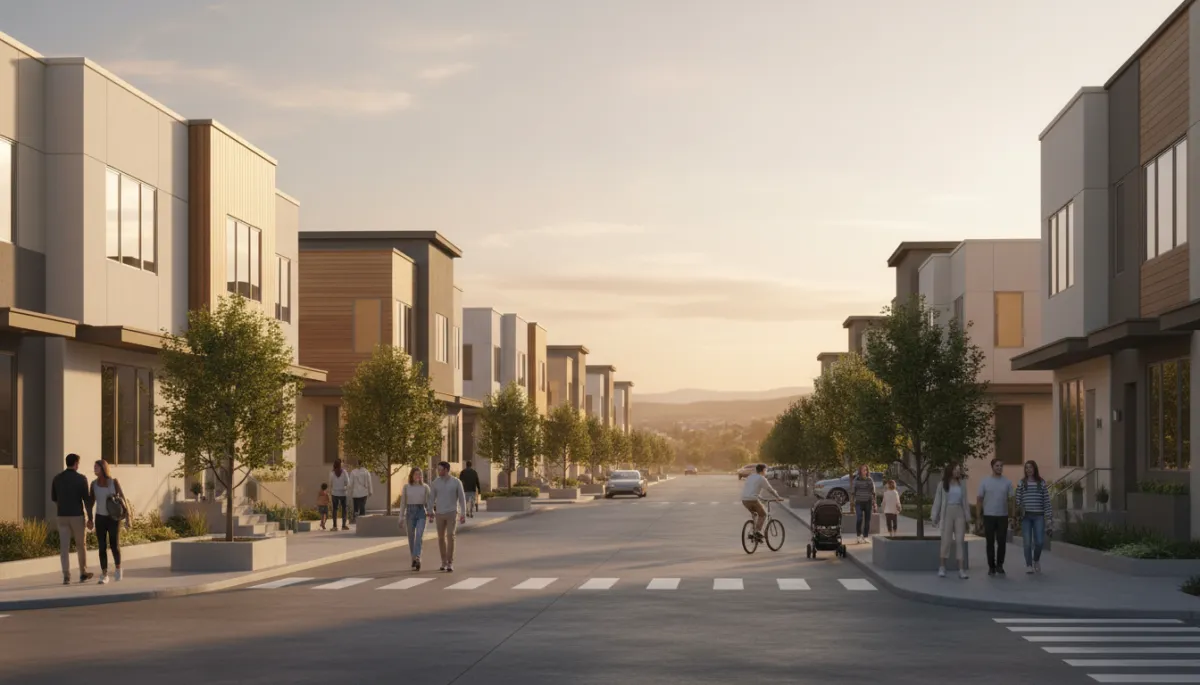
Simple forms, warm materials, and walkable streets define many Utah neighborhoods today.
Architectural Spotlight: Everyday Places That Matter
When we place an architectural spotlight on Utah communities, it often lands on everyday spaces. A small library with generous windows, a school framed by native plantings, or a civic building with a clear, uncluttered entry can quietly shape how residents feel about home and belonging.
These buildings do not need ornate decoration. Their strength lies in proportion, clarity, and a direct response to local needs. Wide sidewalks, bike racks, sheltered bus stops, and simple benches add as much to the architectural story as any facade treatment. In this way, community architecture becomes a framework for daily rituals.
Utah Communities and Cultural Heritage
Cultural heritage in Utah is layered. Indigenous histories, pioneer settlements, mining towns, and newer arrivals all contribute to the built environment. Respectful design acknowledges this without turning every project into a museum. Instead, it uses subtle references: a material palette drawn from local stone, a street grid that follows historic patterns, or a plaza aligned with a long-view corridor.
In some Utah communities, preserved main streets sit beside new infill. When new construction stays simple and restrained, older brick facades and historic details can breathe. The dialogue between past and present remains calm, not competitive. This balance lets cultural heritage stay visible while allowing neighborhoods to evolve.
Designing Forward with Quiet Confidence
Capturing local charm in Utah does not require complexity. It asks for attention: to climate, to culture, to the pace of daily life. When community architecture remains clear and minimal, people, light, and landscape take center stage.
As Utah design continues to evolve, the most enduring Utah communities will likely be the simplest ones. Places where streets are walkable, materials are honest, and cultural heritage is present but not forced. In these quiet neighborhoods, architecture becomes what it does best: a calm backdrop for real life.
Great properties don't stay on the market long! make sure yours get noticed first. Reserve your shoot with DMD Real Estate Photography now to get market-ready visual assets fast."
